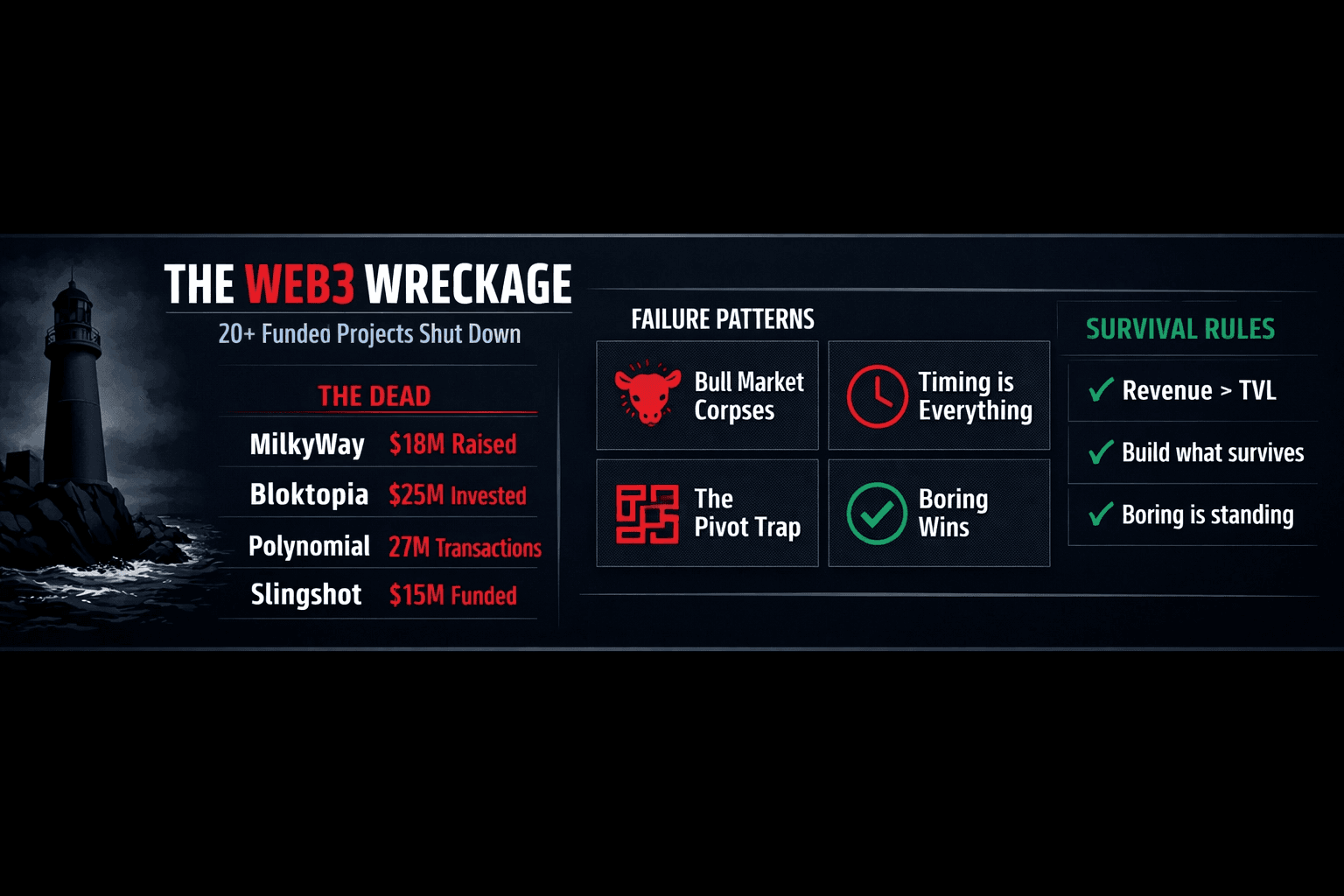
Over 20 funded Web3 projects shut down in the first quarter of 2026. Not scams. Not rug pulls. Real teams with real funding, real products, and real users who watched the lights go off.
This is not a hit piece. Most of these teams did the hard thing: they shipped, they tried, they failed, and they closed down responsibly. But the pattern matters. If you are building in Web3 right now, especially from a market where capital is scarce and second chances barely exist, understanding why funded projects die is more valuable than studying why funded projects succeed.
Here is what happened, and what the wreckage tells us.
The Dead
MilkyWay was the first liquid staking provider for Celestia. They raised $5 million from Polychain Capital, Binance Labs, and Crypto.com. At their peak, they held $250 million in total value locked. The thesis was simple: Celestia's modular blockchain vision would trigger an explosion of DeFi activity, and MilkyWay would be there first with the staking infrastructure to capture it.
That DeFi wave never came. The team pivoted to restaking, then explored real-world asset tokenization and even a rent payment card. None of it found product-market fit. In January 2026, they announced a permanent shutdown. To their credit, they did it cleanly: returned all assets to their original chains, distributed remaining protocol fees in USDC to token holders, and burned all unused team and ecosystem tokens. A $5 million lesson in the cost of betting on someone else's ecosystem.
Bloktopia was a Polygon-based metaverse platform built around a virtual crypto skyscraper. They raised $4.2 million from 32 investors, including Animoca Brands. Their token launched at $0.00025 and hit an all-time high of $0.17 within weeks during the 2021 mania. One of the most dramatic ROI spikes of that cycle.
Their own farewell post was remarkably honest. The metaverse bubble peaked before their product could realistically meet demand. Early test events attracted thousands of users, but servers crashed, sessions dropped, and experiences broke. By the time they fixed the infrastructure, nobody cared anymore. In their words: "the market, product, and community ultimately failed to converge into a sustainable model after the 2021 popularity spike." Bloktopia closed its doors in January 2026, five years after launch.
Polynomial was a DeFi derivatives protocol that processed 27 million transactions and handled over $4 billion in cumulative trading volume. They built more than 70 markets spanning crypto, equities, commodities, forex, and indices. On paper, that looks like traction. But their total value locked peaked at around $8 million, which is thin for a derivatives platform that depends on deep liquidity to function.
They had planned a token generation event for Q1 2026. Instead, they cancelled it, saying openly that launching a token for a dying product would be irresponsible. They ran a phased shutdown: markets suspended on February 13, forced liquidations on February 18, liquidity layer closed on February 24, full chain halt on March 3. The team has hinted at a relaunch. Whether that happens is another question.
ZeroLend was a multichain lending protocol that spent three years building. The shutdown came in February after inactivity across their supported chains hollowed out the platform. Oracle providers discontinued support. Margins in decentralized lending were paper-thin and led to prolonged losses. They set all loan-to-value ratios to zero and entered withdrawal-only mode.
Slingshot started as a hackathon experiment in 2018 and grew into a DEX aggregator that raised $18.1 million from Framework Ventures, Coinbase Ventures, Winklevoss Capital, Digital Currency Group, and Robot Ventures. That is serious money from serious people. When they shut down, they did not even publicly explain why. They just told users to export their private keys and that was it. Eighteen million dollars, and the exit was a one-liner.
Step Finance was a Solana-based portfolio dashboard that went dark in February after a $40 million hack in late January 2026. One security incident, and years of work were erased.
The list keeps going. Nifty Gateway, one of the earliest NFT marketplaces, shut down in February after Gemini decided to refocus on building a super app. Parsec, a well-known DeFi analytics terminal, quietly wound down after five years without even disclosing a reason. Dmail, a decentralized email protocol, admitted it never found a viable business model. Leap Wallet, a popular Cosmos wallet, announced a May shutdown with vague justification. DataHaven, building decentralized storage for AI agents, said they could not find a sustainable path forward despite trying funding, partnerships, and pivots.
The Patterns
If you look at these shutdowns individually, each one has its own story. But zoom out and the patterns become impossible to ignore.
Pattern 1: Bull market funding creates bear market corpses.
Almost every project on this list was funded between 2021 and early 2023. The money came in during peak euphoria, when every narrative had a line of investors behind it. Metaverse, liquid staking, DeFi derivatives, decentralized everything. Checks were written against vibes and TAM slides, not against revenue or retention.
When the market turned, these projects were left holding expensive infrastructure, bloated teams, and token treasuries that were bleeding value. Total DeFi TVL dropped from roughly $167 billion at its October 2025 peak to around $100 billion by Q1 2026. That is a $67 billion evaporation of capital looking for a place to sit. When the tide goes out that far, a lot of boats hit the rocks.
Pattern 2: Being early is often indistinguishable from being wrong.
MilkyWay bet that Celestia would generate massive DeFi demand. Polynomial bet that on-chain derivatives would eat into centralized exchange volume. Bloktopia bet that the metaverse would become a primary interface for crypto. All of these were plausible theses. Some of them may even prove correct eventually. But timing is not a footnote in startup survival. It is the whole story.
Polynomial's own statement captures this perfectly. They said their core strategic direction was correct, but execution fell short of expectations. That is a polite way of saying the market was not ready and they ran out of runway waiting for it.
Pattern 3: Pivoting does not save you if your community is already gone.
MilkyWay tried at least four different product directions after liquid staking demand stalled. RWA tokenization, restaking, a neobank concept, a payment card. None of it worked. Not because the ideas were bad, but because by the time you are on your third pivot, the community that believed in your original vision has already moved on. You are pitching a new product to an empty room.
In Web3, attention is the scarcest resource. Communities do not wait around while you figure things out. They migrate to whatever is generating momentum, and they do not come back when you finally ship something new.
Pattern 4: "Community" was never the moat these projects thought it was.
Every single dead project on this list had a Discord server, a governance token, an ambassador program, and a Twitter account with engagement. Some had tens of thousands of community members. None of it mattered when the product economics did not hold up.
Community without product-market fit is just an audience watching you fail in public. The Discord becomes a support channel for withdrawal questions. The governance token becomes a chart that only goes down. The ambassadors quietly remove the project from their bios.
I have seen this happen up close, from both the builder side and the community side. The hardest part is not the shutdown. It is the months before the shutdown when everyone knows but nobody says it.
Pattern 5: The projects that survive are boring.
While 20+ projects closed shop, Aave kept growing. Morpho kept growing. Compound kept growing. These are lending protocols that have been around for years. They do not chase narratives. They do not pivot to metaverse or RWA or AI agents every six months. They do one thing, they do it well, they have deep liquidity, multiple audits, institutional backers, and visible teams whose reputations are on the line.
Even Aave made a telling move during this period. They shut down their Avara Web3 brand to channel 100% of their focus into their core lending franchise. The biggest winner in DeFi got bigger by getting smaller. That is the opposite of what most dead projects tried to do.
Pattern 6: Clean shutdowns are the new standard, and that matters.
This is actually the one encouraging signal in all of this. MilkyWay returned all user assets, distributed fees, burned tokens, and published the full methodology. Polynomial ran a phased shutdown with clear dates at every stage. ZeroLend disabled borrowing before anything could go wrong.
Five years ago, projects that failed just went silent. Websites went down. Discords got archived. Funds sometimes disappeared. The fact that teams are now shutting down with structure and transparency is a maturation signal. It means the people building in Web3 have enough self-respect and enough respect for their users to die with dignity.
What This Means if You Are Building From the Margins
Most of the coverage of these shutdowns focuses on what went wrong technically or financially. The post-mortem analysis. The autopsy.
But there is a harder question that most Web3 media will not ask: what does this wave of deaths mean for builders in markets where the margin for error is close to zero?
When Slingshot burns through $18.1 million and shuts down without even explaining why, that number is abstract to a VC in San Francisco. It is a write-off. A portfolio loss that gets absorbed across a fund of other bets.
But for a team in Accra or Nairobi or Lagos trying to ship a payments product on a fraction of that, $18 million is not abstract. It is generational. It is the kind of capital that could fund dozens of teams for years. And it evaporated into a DEX aggregator that nobody will remember in six months.
This is not bitterness. It is math. The cost of failure in Web3 is not distributed evenly. A team in New York that loses $5 million in venture funding pivots to the next thing. A team in West Africa that loses a year of building without revenue does not get a clean pivot. They get a hard conversation about whether this industry is worth the sacrifice.
The lesson is not "do not build." The lesson is: build what survives. And what survives, based on everything Q1 2026 just showed us, follows a few rules.
First, do not bet your entire product on another ecosystem's growth. MilkyWay needed Celestia to explode. It did not. If your project only works when someone else's project succeeds, you are not building a business. You are buying a lottery ticket with extra steps.
Second, revenue from day one matters more than TVL, transaction counts, or Discord member counts. Polynomial had 27 million transactions and still died. Vanity metrics look great on a dashboard and mean nothing when the runway runs out.
Third, if you have to pivot more than once, your original thesis was probably wrong. Accept it, shut down cleanly, and start something new with the clarity you now have. The pivot loop is where good teams go to die slowly.
Fourth, boring wins. Not always. Not forever. But in a downturn, boring is what is left standing. Build the thing that works without hype. Build the thing that generates value even when nobody is watching. Build the thing that does not need a bull market to justify its existence.
The Web3 projects that died in Q1 2026 were not failures of ambition. Most of them were ambitious in ways that deserve respect. They were failures of fit. The product did not fit the market. The timing did not fit the opportunity. The economics did not fit the reality.
For those of us still building, especially from places where the resources are thinner and the stakes are personal, the only honest response is to learn from every single one of them. And then keep shipping.